How We Pour
Every commercial pour follows the same five steps. What changes from job to job is how carefully each one is done.
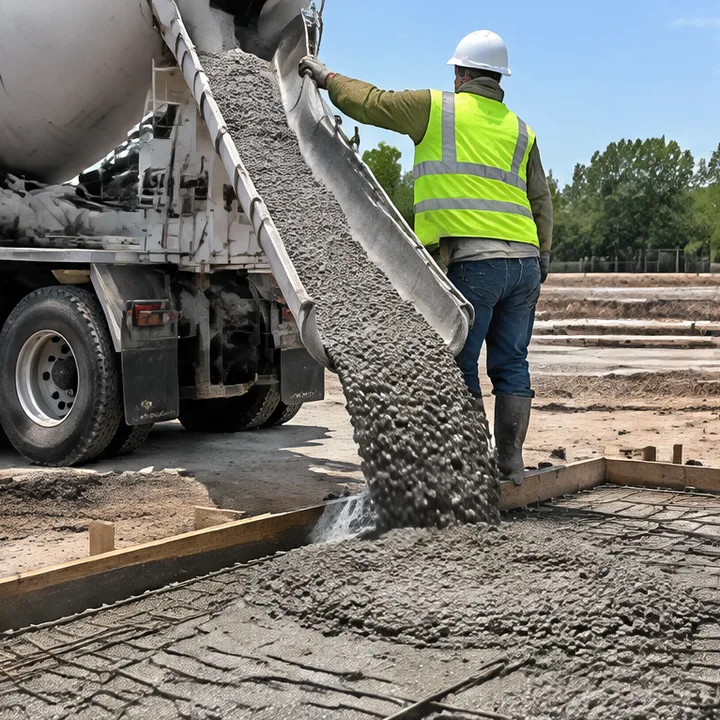
Five steps, start to finish
- 1Survey and subgrade
Stakes go in, the ground is cut, filled and compacted, and the base is graded to a tolerance you can measure with a laser. Every later step depends on this one.
Typical: compaction to 95 percent of standard Proctor
- 2Forms and steel
Edge forms are set to line and grade, the vapor barrier goes down and rebar or fibers go in on chairs, with joints laid out on the plan before a drop of concrete arrives.
Typical: 3 in cover over steel cast against earth
- 3Pour and place
Trucks arrive on a planned rhythm. The chute or pump places the mix, vibrators settle it around the steel and the screed strikes it off to elevation.
Typical: a truck every 10 to 15 minutes
- 4Float, trowel and finish
Bull floats close the surface, bleed water leaves, then power trowels and hand tools bring it to the finish: broom, hard-troweled, stamped or polished.
Typical: finishing starts when the sheen leaves the surface
- 5Cure, saw and protect
Curing compound goes on, joints are sawn in the first hours and the slab is protected from weather and traffic until it reaches its strength.
Typical: saw within 4 to 12 hours, cure 7 days
From the first call to the final cure
- 1Walk the site
We look at the ground, the drawings, the access and the schedule, and list the questions that decide the price.
- 2Price it plainly
You get quantities, scope, schedule and exclusions in writing, with options priced separately.
- 3Build it right
Subgrade, forms, steel, mix and joints are checked before the pour, not after.
- 4Pour and finish
A planned pour with the right crew, pump, finishers and testing on the truck.
- 5Cure and hand over
Curing, protection, joint sawing and a walk-through, so the slab reaches the strength it was designed for.
Why the boring steps matter
- Commercial only
We build for owners, builders and managers: warehouses, retail, offices, hospitals, schools and sites, not driveways.
- Numbers you can check
Quantities, thickness, strength and joint spacing are written down, so bids compare line by line.
- Tested on the truck
Slump, air and temperature at the chute, cylinders cast and broken, results shared with you and the engineer.
- Planned around you
Phased pours, night work and quick-set repairs so stores, shifts and tenants keep running.
- A weather plan
Heat, cold and rain are planned for in the mix, the protection and the schedule, not discovered on the day.
- Forms to finish
One company handles base, forms, steel, placing, finishing, sawing and curing, so nothing falls between trades.
Plan your pour with us
Tell us about the project: the city, the kind of concrete work and when you need it. You get a plain written bid, and a person answers the phone at (800) 290-5816.